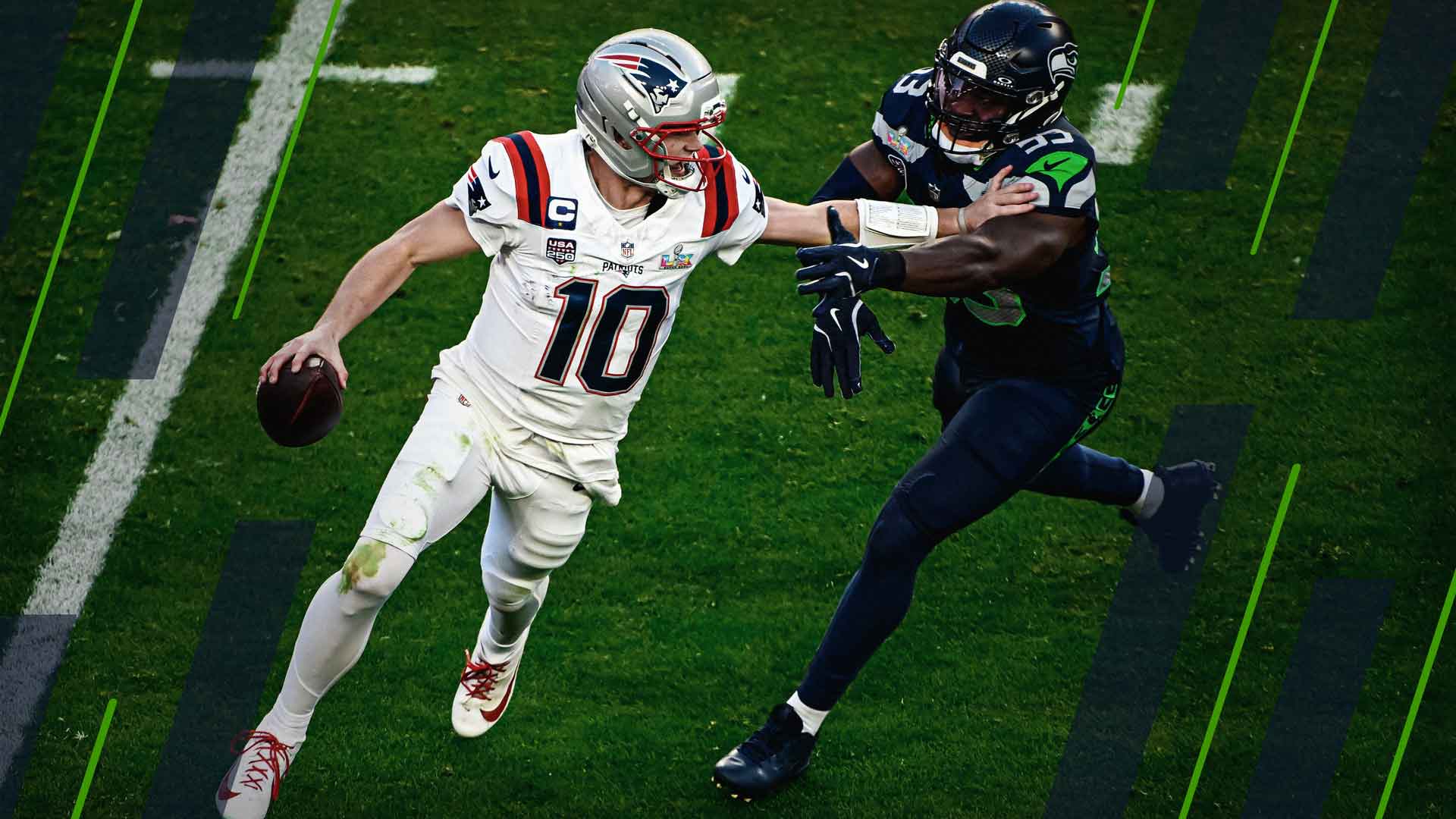
- One of the best defensive performances of the last 20 years: Seattle allowed the third-fewest expected points added (EPA) per play of any Super Bowl defense in the PFF era, trailing only the 2006 Indianapolis Colts and the 2015 Carolina Panthers.
- Despite their pressure rate ranking just 12th in Super Bowls since 2006, when Seattle penetrated the backfield, there was little Drake Maye could offer to escape: The second-year passer finished the game with a PFF grade of 32.4, the lowest of any quarterback to play in a Super Bowl over the last 20 years.
- 2026 NFL Draft season is here: Try the best-in-class PFF Mock Draft Simulator and learn about 2026's top prospects while trading and drafting for your favorite NFL team.
The final stat line of Super Bowl 60 shows that the New England Patriots eclipsed 290 passing yards, averaged more yards per play than the Seattle Seahawks, converted third downs at a higher rate and finished with just three fewer first downs overall.
Anyone who watched the game knows the box score tells a misleading story. While the Patriots strung together two late touchdown drives to add a veneer of respectability, the outcome was decided long before New England ever put points on the scoreboard.
And that's because the Seattle defense — particularly over the first three quarters — delivered one of the most dominant performances in Super Bowl history.
Seattle allowed the third-fewest expected points added (EPA) per play of any Super Bowl defense in the PFF era, trailing only the 2006 Indianapolis Colts and the 2015 Carolina Panthers.
Best defensive performances since 2006
| Defense | Season | Total Snaps | EPA allowed per play |
| Colts | 2006 | 50 | -0.544 |
| Panthers | 2015 | 59 | -0.378 |
| Seahawks | 2025 | 71 | -0.329 |
| Seahawks | 2013 | 69 | -0.312 |
| Eagles | 2024 | 56 | -0.297 |
This went beyond the execution from the eleven players on the field. Mike Macdonald’s defense looked ready for everything the New England Patriots threw at them before the game got out of reach.
One area where Seattle found lots of success was blitzing cornerbacks off the edge. Although the Seahawks blitzed Maye just 13 total times — right around Seattle’s low season average of 25% — it’s where they were coming from that really threw the Patriots’ protection into disarray. The Seahawks found that overloading either of New England’s offensive tackles worked in their favor time and time again.
Seattle blitzed cornerback Devon Witherspoon around the edge seven times. The official stat line for Witherspoon as a pass rusher reads three pressures, two quarterback hits and one sack. However, one of those hits was effectively a strip-sack returned for a touchdown that was officially ruled an interception for Uchenna Nwosu.
SEAHAWKS DEFENSIVE TOUCHDOWN FOR UCHENNA NWOSU OMG
— NFL (@NFL) February 9, 2026
Super Bowl LX on NBC
Stream on @NFLPlus + Peacock pic.twitter.com/9FPzCiciQt
When asked about his success when coming after Patriots quarterback Drake Maye on blitzes, Witherspoon said, “We knew how their tackles and guards were going to set and we went out there and attacked it.”
Witherspoon added that when blitzed by cornerbacks, they had noticed the Patriots offense “were struggling in the playoffs a couple of times, a couple of people got after them … so we knew how we were going to attack them.”
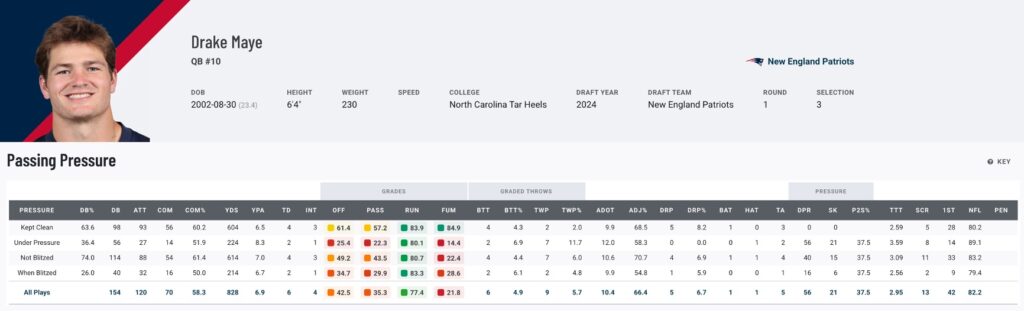
Drake Maye: Performance under pressure in the regular season vs. in the playoffs
| Regular season | Metric | Postseason |
| 37.9% | Pressure rate | 36.4% |
| 20.6% | Pressure to sack rate | 37.5% |
| 86/149 | Comp/Att. | 14/27 |
| 8.4 | Yards per attempt | 8.3 |
| 72.4% | Adjusted comp. % | 58.3% |
| 6.7% | Big-time throw rate | 6.9% |
| 3.2% | Turnover-worthy play rate | 11.7% |
| 61.8 | PFF passing grade | 22.3 |
However, few envisioned the Seahawks’ pass rush looking as dominant as it did on Sunday. Entering the Super Bowl, there were already concerns about Drake Maye’s tendency to hold the ball — an issue that was only magnified during the postseason — along with his poor pressure-to-sack rate, which ranked fourth worst among 32 qualified quarterbacks.
Those concerns resurfaced once again against Seattle’s relentless front. The Seahawks brought Maye down six times, the second-most sacks recorded by a defense in a Super Bowl over the past 20 years.
It officially left Maye’s playoff sack tally at 21 — the most sacks any quarterback has ever taken in a single postseason run.
NFL quarterbacks: Most sacks taken in a single postseason run since 2006
| Quarterback | Season | Sacks |
| Drake Maye | 2025 | 21 |
| Joe Burrow | 2021 | 19 |
| Jalen Hurts | 2024 | 13 |
| Eli Manning | 2011 | 11 |
| Patrick Mahomes | 2024 | 11 |
| Deshaun Watson | 2019 | 11 |
| C.J. Stroud | 2024 | 11 |
Despite their pressure rate ranking just 12th in Super Bowls since 2006, when Seattle penetrated the backfield, there was little Maye could offer to escape. The second-year passer finished the game with a PFF grade of 32.4, the lowest of any quarterback to play in a Super Bowl over the last 20 years.
Seattle’s success on first to third down rendered New England hopeless on fourth down. They forced a Patriots team totally devoid of confidence to punt eight times.
One aspect of Super Bowl 60 that unfolded exactly as expected was New England’s inability to generate anything on the ground. The Seahawks finished with an 84.9 PFF run-defense grade, the third-highest by any Super Bowl defense in the PFF era — notably trailing only two other Seahawks teams from 2013 and 2014.
This version of the Seahawks is not the Legion of Boom, but it may be the closest approximation the league has seen in the decade since. After finishing the season as the most gap-disciplined defense in the NFL, Seattle executed nearly flawlessly on Sunday, missing just one tackle on New England rushing attempts.
Super Bowls since 2006: Highest team run-defense grades
| Team | Season | Team run-defense grade |
| Seahawks | 2013 | 91.0 |
| Seahawks | 2014 | 85.5 |
| Seahawks | 2025 | 84.9 |
| Broncos | 2013 | 82.0 |
| Patriots | 2007 | 80.8 |
| Patriots | 2018 | 80.0 |
| Rams | 2021 | 76.0 |
| Chiefs | 2024 | 73.8 |
| 49ers | 2023 | 73.7 |
| Broncos | 2015 | 71.1 |
Seattle’s efforts against New England’s running backs were highlighted by Ernest Jones, who posted an 86.6 run-defense grade. Patrick Willis in Super Bowl 47 and Leo Chenal in Super Bowl 58 are the only linebackers to post higher run defense in the biggest game on the calendar.
The ceiling of this Seahawks performance is likely capped by a fairly ordinary showing in coverage. Seattle finished the game with a 55.4 PFF coverage grade — its fourth-worst mark of the 2025 season — a number further dragged down by missed tackles on six of Drake Maye’s completions.
Still, many of Maye’s incompletions were self-inflicted or the direct result of relentless pressure from Seattle’s front four. The Seahawks rarely needed to do much on the back end, even squandering a prime interception opportunity when Maye lofted a desperation throw to Mack Hollins into triple coverage. Seattle would make up for it four plays later, securing the game-sealing interception anyway.
In the end, the Seahawks simply became the latest champions to underscore a timeless truth: dominance in the trenches wins championships. They didn’t need to disguise endlessly, gamble for turnovers or win consistently on the perimeter. Instead, they overwhelmed the Patriots at the line of scrimmage and dictated the terms of the game, snap after snap.
Drake Maye held onto the ball, seemingly paralyzed by the fear of making mistakes that, in the end, felt inevitable. As the game wore on, it became increasingly clear that New England would have to push the ball downfield — a task they were wholly unequipped to handle.
The true story of Super Bowl 60 may ultimately be obscured by late points and a misleading box score, but the tape tells a far harsher truth. This was both a masterclass defensive performance by Seattle and an offensive disaster of historic proportions from New England.
This wasn’t the Legion of Boom reborn — the talent level simply isn’t the same — but it was something more modern and more surgical. In many ways, it was a perfect encapsulation of Mike Macdonald. He relentlessly emphasizes detail and discipline, and on Sunday, his defense looked exactly like what he envisioned when he took the job two years ago.
Perhaps the most unsettling takeaway for the rest of the NFL is that this performance doesn’t feel like lightning in a bottle. There’s a strong chance Macdonald will coach even more talented defenses during his tenure as a head coach.
One of Macdonald’s most telling comments after Sunday night’s win was that he wished the season could keep going. That sentiment speaks volumes about his passion for the job — and it should serve as a warning sign.
As long as he’s in charge, the Seahawks look poised to remain a major force in the league.

 © 2026 PFF - all rights reserved.