- LAST CHANCE FOR 40% off: Use promo code BLACKFRIDAY to unlock the PFF Player Prop Tool, Premium Stats, fantasy dashboards, the PFF Mock Draft Simulator, industry-leading fantasy rankings and much more. Act fast, the deal ends tonight!
At the very top, the 2026 NFL Draft class is shaped by defensive talent, particularly a good group of edge defenders and a nice crop of wide receivers and cornerbacks that occupy a significant share of the top 50.
Overall, this class blends blue-chip defensive playmakers, a deep perimeter talent pool and a more meaningful cluster of quarterbacks worthy of early consideration than last cycle.
For the full ranking of draft prospects — including three-year player grades and position rankings — click here. And if you want to go hands-on with the class, check out the PFF Big Board Builder to create your own rankings or fire up the PFF Mock Draft Simulator to run full mock drafts in seconds.
Editor’s note: The analysis included here comes from Trevor Sikkema’s preseason scouting series, while the rankings themselves have been fully updated. This analysis is provided to give readers context on how these players were viewed entering the season.

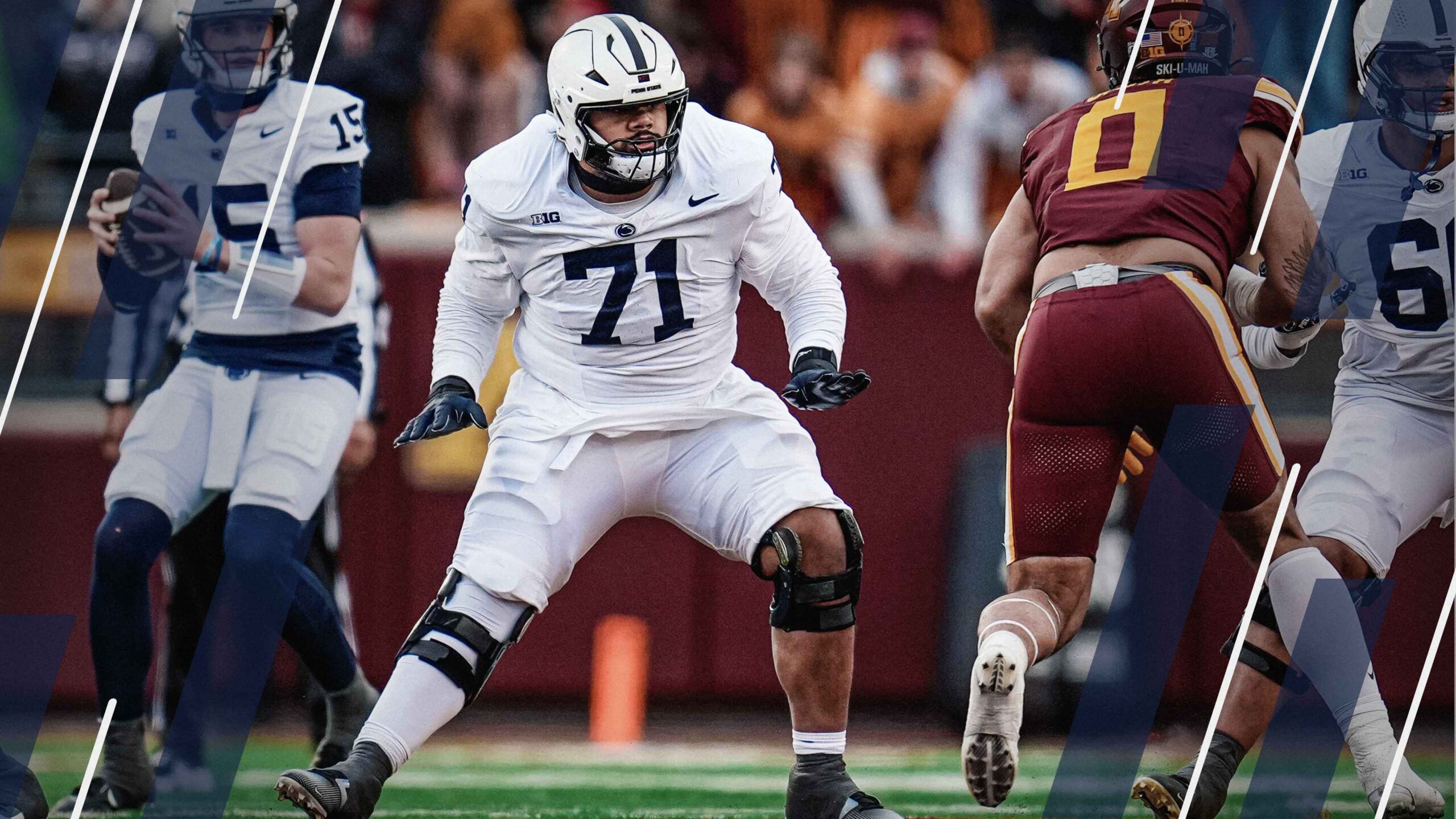
1. Olaivavega Ioane, Penn State Nittany Lions
Big board rank: 28
Ioane is a densely built guard prospect who does a lot of things well when projected to a downhill man or gap run-blocking scheme. Along with football, he grew up playing rugby and basketball, giving him an intriguing multi-sport background. He has a low, wide and powerful pre-snap stance, which gives him a good first step for reach blocks and power when blocking downhill. He does a good job of hand-fighting with coordination and balance to reposition in pass protection. His wide base helps him neutralize some pass-rush moves, but he can struggle with lateral movements, such as when outside zone-run blocking and facing cross-face pass-rush moves.
2. Connor Lew, Auburn Tigers
Big board rank: 33
Lew has the chance to be a really good center prospect. His wide, low base in his pre-snap stance sets the stage for a fundamentally sound approach to blocking. It allows him to win the leverage battle consistently. He also has great posture in his posterior chain with a flat back, keeping his feet underneath him at all times for good balance with the ability to take and dish out power on any step. He is a bit light and can sometimes struggle against the best bull rushes, and he must also be more consistent with his stride timing and with readjusting his hands during reps. However, there is so much to like about how he plays the position as one of the youngest prospects in the class.
3. Charles Jagusah, Notre Dame Fighting Irish
Big board rank: 40
Despite subpar arm length, Jagusah looks the part of a starting NFL offensive lineman. He is limited in experience but is oozing with talent. His wrestling background (undefeated state champion) gives him elite body control and core strength. This benefits his posture, anchoring power, and recovery ability if a rush move beats him. He can mirror rushers with a wide base and plus footwork. He has a history of injuries (a torn pectoral muscle and a broken arm) that have kept him from getting valuable starter reps. If he plays more of those snaps, we could see him blossom into a top-50 type of player.
4. Jake Slaughter, Florida Gators
Big board rank: 66
Slaughter is a smart, savvy center prospect who does his best work when he can showcase his athleticism behind mid- and outside-zone blocking concepts. He's coordinated and impactful in space and at the second level. His quick first step enables him to gain leverage on defenders quickly, which helps him mitigate some of his small stature. NFL-level power and length can give him trouble when he's blocking one-on-one, but this is a field general type of center prospect.
5. Chase Bisontis, Texas A&M Aggies
Big board rank: 77
Analysis Coming soon!
6. Emmanuel Pregnon, Oregon Ducks
Big board rank: 91
Analysis Coming soon!
7. DJ Campbell, Texas Longhorns
Big board rank: 134
Analysis Coming soon!
8. Keylan Rutledge, Georgia Tech Yellow Jackets
Big board rank: 141
Analysis Coming soon!
9. Kobe Baynes, Kansas Jayhawks
Big board rank: 169
Analysis Coming soon!
10. Jaeden Roberts, Alabama Crimson Tide
Big board rank: 172
Roberts will be one of the strongest prospects at any position in the 2026 NFL Draft. He has a hulking frame that packs a serious punch — when his hands hit a defender, they are jarred back. When he gets his hands up and in a defender's chest, it's a wrap. He has some lapses in posture, and he tends to lunge and miss his target, which isn't necessary given his notable play strength. In pass protection, he is tough to get around, but his feet can be heavy when mirroring defenders and maintaining blocks. He's a true power guard who has some room to improve in pass protection.
11. Logan Jones, Iowa Hawkeyes
Big board rank: 190
Jones is a feisty, high-intelligence center prospect who has experience at both center and even defensive tackle at the college level. He has quick footwork and good overall athleticism, enabling him to reach and block effectively in zone-blocking schemes. He's also very comfortable hand-fighting and repositioning. His arm length isn't just short; it's outlier-short, even for a center. This makes it easier for defenders to cross his face and shed his blocks, even if he gets his hands inside.
12. Ar'maj Reed-Adams, Texas A&M Aggies
Big board rank: 197
Reed-Adams is a downhill, ass-kicker type of interior offensive lineman who brings ideal size and plus length to the guard position. He's a coordinated and well-balanced athlete for his size and does his best work with combination, climbing or pulling blocks in power run-blocking schemes. He lacks quick-twitch in all of his movements, especially when moving laterally, so zone-blocking assignments are more of a chore. In pass protection, he uses a low, wide base and that, plus arm length, to make it very tough to beat him to either side.
13. Parker Brailsford, Alabama Crimson Tide
Big board rank: 212
Brailsford will enter the NFL with outlier measurables that require a leap of faith to draft. His Washington tape was excellent in 2023 and showed him consistently winning with quickness and finesse while mitigating concerns about strength and length. However, that was not the case in the SEC in 2024. He could still move his feet well and stay in front of defenders in pass protection, but his lack of strength and weight really showed up in his lack of impact in the run game between the tackles. His fleet-footed style lends itself to an outside-zone blocking scheme.
14. Iapani Laloulu, Oregon Ducks
Big board rank: 240
Laloulu is a dense, thick-bodied interior player who seems to have the overall size and length to play guard or center. He's a phone booth type of blocker who wants to hit defenders between the shoulders with nice pop on contact. That mauler mentality can get him in trouble, though, as he goes for the kill shot in space too often. He struggles to reach landmarks on outside zone runs, and he plays with a higher pad level than he should, given his natural leverage. Laloulu is still rounding out his game, but he has the look and feel of a man- or gap-scheme center.
15. Ethan Onianwa, Ohio State Buckeyes
Big board rank: 244
Onianwa has a dense frame that could hold up inside at guard, but he does have the arm length that could give him a shot at tackle in the NFL, especially if he holds up there at Ohio State. His lower body has a ton of mass, and he can generate a ton of power due to his wide base and low pad level. He has a finisher's mentality as a run blocker, but sometimes gets too obsessed with pushing defenders rather than maintaining the block. His long arms help mitigate the fact that his kick slide doesn't cover much ground. We are eager to see how he will play in the Big Ten.
16. Joshua Braun, Kentucky Wildcats
Big board rank: 252
As strange as it might be to explain, Braun is a bit of a finesse guard at 6-foot-6 and 350 pounds. He's heavier, but his feet stay moving at all times. His build makes him naturally tough to get around in pass protection, especially when lined up as a guard, due to mass and offensive tackle-like arm length. He doesn't have the explosiveness at his size for consistent stretch zone blocking, but he also seems to lack that pop and mauling strength you want for a downhill blocker. He seems quite reliable in pass protection for a super-sized lineman, but he needs more of a mean streak as an impact run blocker.
17. Pat Coogan, Indiana Hoosiers
Big board rank: 265
Analysis Coming soon!
18. Connor Tollison, Missouri Tigers
Big board rank: 280
Tollison is an experienced, quick center prospect with a skill set that lends itself to an outside-zone run-blocking scheme. His feet are light and fast, which allows him to fire out of his stance for stretch and reach blocks as well as mirror cross-face moves. His lack of arm length impacts his ability to maintain blocks in pass protection. He also struggles to generate leg drive in the run game. He has the speed, but you have to live with the shortcomings in the weight and length departments as a center-only prospect.
19. Tomas Rimac, Virginia Tech Hokies
Big board rank: 291
Rimac has been a consistent starter for West Virginia for three seasons and now enters both his first and final year at Virginia Tech. He has plus size and length for an interior lineman, which gives him some potential to be a swing lineman on the depth chart. He can get low in his pre-snap stance, but generally struggles to play with a low pad level. He has a bad tendency to dip his head on contact and can sometimes seem lost in space. However, he does have a good first step for reach blocks on inside zone runs.
20. Bryce Foster, Kansas Jayhawks
Big board rank: 299
Foster maximized his college eligibility by returning for the 2025 season, but that could be the best move for him. He had his best year after his 2022 ACL injury in 2024 for Kansas. He has adequate height and weight to play either guard or center, but his shorter arms could make him a center-only player in the NFL. He has a nice first step and is not only coordinated but also strong when zone blocking. Foster also brings pop on contact with a finisher's mentality. His pad level is a bit high, but correcting that could lead to even more success in 2025.
21. Davion Carter, Texas Tech Red Raiders
Big board rank: 309
Carter has outlier size for an NFL prospect. His lack of height and length likely push him into the center spot in the NFL, but he has not played there in his college career. However, his lack of height has its leverage advantages, and his hands are fast. At the same time, his balance can be consistently manipulated against interior defenders with even average arm length. It also takes him a few more hops or steps to mitigate bull rushes at his lower weight.
22. Roderick Kearney, Florida Gators
Big board rank: 314
It's hard to judge Kearney much, given how little he has played entering 2025. He shows good baseline athleticism for the offensive line, with a good first step, coordinated running in space and balance, which is why he fits best in an outside zone blocking scheme. However, he needs to get stronger and has to play more to improve his anticipation and eyes. We'll check back in once he gets some starts under his belt.
23. Luke Petitbon, Florida State Seminoles
Big board rank: 315
Petitbon will have a ton of experience to boast in the 2026 center class, as he will be 25 years old during his rookie NFL season. He is a smart offensive lineman who wins with good technique, positioning and anticipation. However, he is physically limited in stature and speed. Despite his lower weight and strength profiles, he projects best to a man- or gap-blocking scheme, where he can be a help blocker and mitigate how often he'll need to impact-block one-on-one.